



Texas Instruments OPA835 & OPA836 Ultra Low-Power Op-Amps
Texas Instruments OPA835 and OPA836 Ultra Low-Power Op-Amps feature single ultra-low power, rail-to-rail output, and negative rail input. These voltage-feedback operational amplifiers are designed to operate over a power supply of 2.5V to 5.5V. The TI OPA835 consumes only 250µA per channel and a unity gain bandwidth of 56MHz while the OPA836 consumes only 1mA per channel and a unity gain bandwidth of 205MHz. These TI op-amps provide an industry-leading power-to-performance ratio for rail-to-rail amplifiers. The high-frequency performance and low-power consumption provide performance versus power not attainable in comparable devices. That performance, coupled with a power savings mode to reduce the current to <1.5µA, makes these TI devices an attractive solution for high-frequency amplifiers in battery-powered applications.
Features
- OPA835
- Ultra-low power
- 2.5V to 5.5V supply voltage
- 250µA (typ) quiescent current
- 0.5µA (typ) power-down mode
- 56MHz bandwidth
- 160V/µs slew rate
- 10ns (2 VSTEP) rise time
- 45ns (2 VSTEP) setting time
- 195ns overdrive recovery time
- 9.3nV/rtHz (f = 100kHz) input voltage noise
- 100µV (500µV max.) input offset voltage
- 113dB CMRR
- 40mA output current drive
- Rail-to-rail output (RRO)
- -0.2V to 3.9V (5V supply) input voltage range
- -0°C to +125°C operating temperature range
- OPA836
- Low power
- 2.5V to 5.5V supply voltage
- 1mA (typ.) quiescent current
- 0.5µA (typ.) power-down mode
- 205MHz bandwidth
- 60V/µs slew rate
- 3ns (2 VSTEP) rise time
- 22ns (2 VSTEP) setting time
- 60ns overdrive recovery time
- 4.6nV/rtHz (f = 100kHz) input voltage noise
- 65µV (400µV max.) input offset voltage
- 116dB CMRR
- 50mA output current drive
- Rail-to-rail output (RRO)
- -0.2V to 3.9V (5V supply) input voltage range
- -40°C to +125°C operating temperature range
Applications
- Low-power signal conditioning
- Audio ADC input buffer
- Low-power SAR and ΔΣ ADC drivers
- Portable systems
- Low-power systems
Related Products
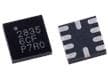
Texas Instruments OPA2835 Dual VFB Op Amps
Leading power-to-performance ratio for rail-to-rail amps.
Opublikowano: 2011-12-19
| Zaktualizowano: 2022-03-11